Viagra

Tag Archive for 'Deliver with Style'

Five ways to know if you are a presentation professional or a presentation amateur

Professional or amateur?

What is a professional? My key words are high standards, excellence, role-modelling, expertise, high status and remuneration.

The original meaning of amateur comes from the Latin root for love {amo} and used to be applied to hobbies and sports eg Olympian athletes had to be amateurs until the 1970s and today all boxers must still be amateurs. While it does have positive meanings, the word tends to be used more with “sub-par” and shoddy performance. Used as an contrast to professional performance.

I am a keen observer of business presentations, and have seen common behaviours that I think are amateur and should not be employed by business professionals, especially the C-level executives that I work with. If you are doing the following five things in your presentations, you might wish to consider the message you are sending your audience, and consider taking a more professional approach:

#1 You hit the microphone before you speak [to test that it is on].

The message you send the audience: “I have not done a sound check before the meeting and I have no concern at all that blowing or hitting the microphone sounds awful and looks worse.

The Professional’s approach: You arrive early to the venue. You seek out the technical staff. You check the volume and sound quality from all the microphones. You prepare a backup microphone. You make sure that there is no feedback from the microphones when you move around on the stage.

#2 You run your presentation off a USB stick

The message you send the audience: “I didn’t think through the possibility that there would be a problem. Don’t worry, I’ll take a couple of minutes during the presentation to reload my USB and presentation.”

The Professional’s approach: You realise that it’s quite easy for a USB stick to disconnect, and that the most stable solution causes the least problems. You load your presentation onto the computer’s desktop. You test it by running through all your slides. You still plug in your USB stick as a backup. It’s there in the unlikely event that you will need it.

#3 You read from your slides

The message you send the audience: “I have done so little preparation that I don’t know what I really want to say, so I have written my whole script on this slide. And now I am going to read it word by word, even though you can read it much faster than I can say it.”

The Professional’s approach: You understand that text based slides are boring, dull and result in very poor memory retention. You know that the audience switches off when they see such slides. You rehearse thoroughly so that you have a clear message which each slide supports. You make your slides more visual - using pictures, simple charts and tables - rather than dumping data or cramming text. You prepare a handout if you need to pass on technical details or financial information.

#4 You walk across the screen while you are presenting

The message you send the audience: “I am so unaware of how this looks, that I think it’s fine to walk in front of the screen, stretch across the screen to reach the computer to advance the next slide, or even present with the slide projecting onto my face.

The Professional’s approach: You understand that a presentation is a performance where you are in control of the stage including the technology and lighting. You use a wireless clicker to remotely advance slides. You practice with the clicker so you know how to use it. You are discreet while using it and point it at the computer - not the screen - when advancing slides. You ‘black out’ the screen when you need to walk across the stage so that the slide is not projected onto your face. You are in control of how and when the audience sees the slides. The slides support you and your message, not dominate the whole presentation.

#5 You finish with the Q&A

The message you send the audience: “I don’t mind the presentation finishing with low energy, or the final words being, ‘No more questions? I guess I’m finished then.”

The Professional’s approach: You know that the main purpose of a presentation is for you to deliver a message to your audience that they will remember, take away and possibly act on. You know that question and answer sessions often peeter out and are not a strong way to round off a presentation. You have prepared - and perhaps scripted - your close so that your key messages get reinforced and the audience know exactly the next step they should take upon leaving your presentation. There is a clear and motivating call to action.

About the Author

Warwick J Fahy

“I work with senior executives working for multinationals in Greater China who lack the executive presence to effectively influence key stakeholders. While these executives are very smart, very knowledgeable and highly capable, a key piece missing. Their executive communication skills need polishing. I help executives build a strong foundation in executive communication so that they are able to better think, speak and act like a leader to set and implement strategy. Recently, we helped a CEO turn his communication style from being nervous and uninspiring into a more engaging, confident and purposeful executive.”  Learn more about who I help here.

Find out whether your executive team is performing to the best of their potential with Warwick’s article “10 Warning Signs Your Leaders Lack Executive Presence”. Email me and I’ll send you a PDF version.

Warwick is the author of “The One Minute Presenter: 8 steps to successful business presentations in a short attention span world”. Warwick is author of the forthcoming book ‘Speak with Executive Presence in China’

Now available on Amazon.com.

Sign up to “52 Tips to more confident public speaking” newsletter at www.warwickjohnfahy.com
©2011 Warwick John Fahy

Deliver with Style: Making more memorable slide decks

In running The One Minute Presenter workshops around Asia, we encounter the pains and challenges of “death by PowerPoint”.  The main problem is that business presenters mis-use the tool - treating it more like a word processing tool than a visual aid software. We see slides crammed full of text because the presenter wants the crutch of being able to read the text in case they  forget what to say. In other words, they are putting their script on the slide. This is a lazy approach to business presenting. It replaces proper rehearsal with text heavy, instantly forgettable data heavy slides.

A large part of our workshop  shows how to create a message and connect it to the audience. In this article, we will cover three simple tips you can use to create more attractive and memorable slides.  We frequently work with technical presentations and financial presentations and these skills can be applied to these situations as well. Remember that the golden rule while presenting is variety.

Tip 1: Use full slide pictures

full-page-visual1

Instead of packing text onto the slide, use full screen pictures to add impact. In this example you can use it as an opening slide for a section, or as a talking point.  You show the picture and then relate how it is relevant for the message you are delivering for your audience.

Tip 2: Use metaphors and taglines

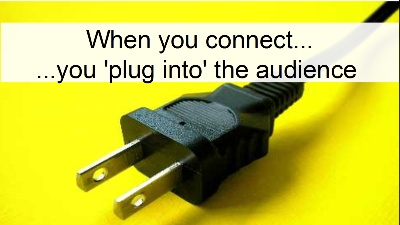
metaphor-with-tagline In this example, a picture is used as a metaphor. It conveys the meaning behind the message. The added tagline “when you connect you plug into the audience” reinforces the meaning. In this case, as a presenter you may not need to add anything further. Simply letting the audience read the slide can be effective.  Don’t fall into this trap: reading every word on the slide. Often it’s not necessary as the audience can read quicker than you can speak.

Tip 3: Add a summary slide

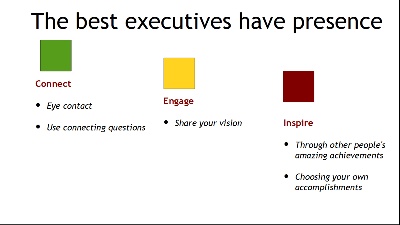
summary-page Get into the habit of recapping every section and adding a summary slide at the end of the presentation. It allows the audience to mentally catch-up and by refreshing what you said they can digest the message. This will improve memory recall rates and importantly it can be used as an opportunity for you to answer relevant questions to that section. Summary slides should be clean with key points only. No new information should be added. The purpose is to simply review the previous messages.

Summary

While this is not an exhaustive coverage of slide design, critically look at your slides and ask yourself if you are using them as your script or are they truly an aid for the audience to better understand your message. Be audience-focused not presenter focused and you will be on the road to getting your point across in an engaging and memorable way.

About the Author: Warwick J Fahy

“I work with C-level executives working for multinationals in Asia Pacific who lack the executive presence to effectively influence key stakeholders. While these executives are very smart, very knowledgeable and highly capable, a key piece is missing. These executives’ communication skills need polishing.

I help executives build a strong foundation in executive communication so that they are able to better think, act and communicate like a high performing leader. Recently, we helped a CEO turn his communication style from being nervous and uninspiring into a more engaging, confident and purposeful executive.” Learn more about who Warwick helps here.

Warwick is the author of “The One Minute Presenter: 8 steps to successful business presentations in a short attention span world”.

Now available on Amazon.com.

Sign up to “52 Tips to more confident public speaking” newsletter at www.warwickjohnfahy.com
Unplanned speaking made easy with the Open your Mind framework: Slideshare Presentation

You can watch and follow along with this audio training speech on “Open Your Mind: How to always be ready for any unplanned speech” at slideshare. The link is here.

While this presentation was delivered in a Toastmasters club, it is relevant for many business presenters who need to speak without much preparation time.

Please comment and let me know if there are other topics you would like to see covered.

About the Author

Warwick J Fahy

Warwick helps C-level executives, working in multinational companies based in Greater China, who struggle to get their point across and influence their key stakeholders. Warwick helps the executive project their message with confidence allowing them to express their opinions powerfully and gain respect from senior managers even when under pressure.”  Learn more about who I help here.

Warwick is the author of “The One Minute Presenter: 8 steps to successful business presentations in a short attention span world”.

Now available on Amazon.com.

Sign up to “52 Tips to more confident public speaking” newsletter at www.warwickjohnfahy.com
The King-Size Fears of Public Speaking

Tips to improve your next presentation

Is the fear of public speaking really such a big fear? The uncomfortable moments in the Oscar winning The King’s Speech, probably felt painfully familiar to many who have been under pressure while presenting. It certainly did for me and as someone who went to a speech therapist for elocution lessons as a child it made me think what we can take away from watching a movie about a man learning to manage his stammer. This article will cover some of the good tips and dispel the bizarre.

The King’s Tip: Always stand up to deliver a speech of importance.

An engaging speaking voice is very relevant today, as many business presentations are given through teleconferences. The lack of visual cues makes it harder for listeners to catch the message and tougher for speakers to read the audience. Standing up places you in an assertive posture and allows deeper breathing from your diaphragm which aids better vocal quality projection. Opera singers could deliver with such a wide range while sitting. Strengthening your abdominal muscles enables you to better fill your lungs with air. So you now have another reason to get to the gym. It’s optional whether you would want to have your wife sitting on your stomach.

The King’s Tip: Gradually expand your ability to project your voice.

Adding strength and authority starts with becoming comfortable with the sound of your own voice. Before I became a professional speaker, I was incredibly shy and self-conscious when speaking to groups. Partly this is because I am a natural introvert like many professionals in finance, IT and engineering. This can’t be changed overnight but like any skill can be developed. Practise your presentation out aloud, ideally in a meeting room, and project your voice so that someone at the back of the room would hear. While you don’t need to sing out your windows, find fun excuses to raise your voice, like playing sports or refereeing a football match at your children’s school.

Aside from voice improvements, the movie also highlights the importance of preparation and rehearsal.

The King’s Tip: Great speakers are made, not born.

No infant starts to speak with a stammer and no one starts with a fear of public speaking. Conversely, no one is born a natural public speaker. Circumstances, experiences and environment all play a key part in how people develop. I had a bad experience in a school drama class that put me off public speaking for decades. The good news is that these fears can be overcome. Hard work and determination to improve are the greatest success factors in becoming an effective public speaker. How many presenters could match the King’s dedication when he visited his speech therapist 82 times before a six month world tour? Many presenters do not allocate any time to rehearse their speech. If you have three weeks to prepare a totally new 20 minute presentation allow between 30 minutes and 1 hour a day for preparation and time-block it in your calendar. You wouldn’t expect to become a better swimmer if you never went to the pool, so find the time to practice your speaking skills.

The King’s Tip: Learn to self-evaluate

You don’t learn by doing, you learn by re-doing. Accelerate your learning by listening to your presentation on a video or audio recorder. This highly effective way makes you more aware of the areas you need to focus on – if you can get over the embarrassment of looking or listening to yourself! After watching a recording, take a piece of paper and divide it into two halves. Write down all your strengths on one side and areas that you would like to improve on the other. You will be surprised after this exercise, sometimes you sound better than you imagined. Most audiences don’t judge us as harshly as we critique ourselves.

Tips to avoid

Tips to avoid include relaxing your throat by smoking deeply into your lungs! Voice care is important so drink plenty of water and add lemon or honey. You can also lightly massage your vocal chords before you start presenting. Another piece of bad advice is “always start with a joke”. While humour can connect with your audience, it’s such a high risk approach. You might offend, not deliver it with the best timing or just not tell a funny joke. Not the best way to start your presentation.

In addition to the above tips, The King’s Speech highlights two key lessons. Firstly, only you can change you. If you don’t want to improve or if you don’t think it’s that important then your progress will reflect that. Secondly, being consistent and realistic about changing an engrained behaviour is essential. Put some time aside to rehearse and the improvements will follow.

About the Author

Warwick J Fahy

“I work with high-potential senior executives who need to be more confident and influential with their key stakeholders. I help the executive quickly and powerfully express their opinions into message based presentations - even when under pressure.”  Learn more about who I help here.

Warwick is the author of “The One Minute Presenter: 8 steps to successful business presentations in a short attention span world”.  Buy or download the book here.

Now available on Amazon.com.

Sign up to “52 Tips to more confident public speaking” newsletter at www.warwickjohnfahy.com

If you have ever sat through a presentation and felt like this picture, then give us a call. We help executives learn how to get to the point and create memorable and persuasive presentations. Call us on +86 21 6101 0486

“Ever feel like the presenter is making too many points?”

Photo credit: Piotr Bizior

Two Key Executive Speaking Skills: Get to the Point and Project your Voice

The opening of The King’s Speech, starts with the King stammering his way through a speech in front of 120,000 people. While you may not face that level of pressure, having the ability to deliver effective presentations is an important skill to fast track your career, especially into senior ranks. Often a better presenter will be promoted ahead of a manager with superior technical skills. As an executive speech coach, I am invited to work with senior executives to help them iron out difficulties they have communicating with their key stakeholders, like board of directors or clients. Here we examine two common obstacles facing managers and executives in China and suggest a few solutions. Don’t worry, none of them involve smoking cigarettes or putting marbles in your mouth!

Obstacle One: Getting to the point

Many business presenters struggle to get to the point. They over-elaborate and leave audiences wondering, “What’s your point?” half-way through the presentation.

Sometimes changing industry is the cause. Jessie Wang, a 15-year veteran from a Big 4 consulting firm, switched to become an in-house tax specialist for a high-end real estate developer. Unlike her previous experience, where after submitting a client report, she had no connection with follow-through, now commercial directors expected advice and recommendations on how to implement a project. Although everyone regarded Jessie as an expert, frustrations emerged in meetings and telephone calls with the directors. Jessie gave rambling presentations covering tax legislation in too much detail. Her audience simply wanted to grasp the main point quickly and directly. Under time pressure and with millions of dollars investment on the line, they needed the best advice to make a decision and move on.

The solution worked on two levels.

Firstly, I helped Jessie understand how to construct a message-based presentation using a technique called the inverted pyramid. This technique puts the crucial information and message at the start and adds supporting points in decreasing order of importance. This executive summary approach uses the opening one to two minutes to outline the core message and key points to the audience who can then relax as they know where the presentation is heading. Secondly, to help Jessie adopt an in-house expert approach, I introduced a framework into which Jessie could slot her content. I work with 12 presentation frames and selected one that enabled Jessie Wang to cut out the irrelevant technical details, and finish the presentation with a strong recommendation. One approach divides the content into three parts; the problem, a range of possible solutions to address this issue, and finally a recommendation with caveats.

The resulting shorter, more outcome focused meetings helped lower tensions and improve key relationships with the commercial directors.

Obstacle two : Improving vocal projection

A common theme in The King’s Speech was vocal projection and this is a common obstacle facing many presenters. Jacky Li works in a Beijing professional services firm and as a new partner is expected to represent the company at industry events and bring in new business. Like many technical experts working in finance, IT, and engineering, Jacky is naturally an introvert, and is brilliant working with numbers and processes. Over the years by going deeper and deeper into his expert silo, he has secured consistent promotions. However, at this stage in his career, he needed to switch from being a technical expert to a more outgoing executive working with a wider range of stakeholders.

Two barriers stood in the way. Firstly, a lack of confidence at the daunting task of this expanding and unfamiliar role. This is common for newly promoted executives who find that their new portfolio includes a skillset that they have never developed. Secondly, Jacky had a very quiet voice, also common with introverts. This was not a problem when communicating one-to-one, but became a major fear factor when facing prospective clients or a conference hall full of industry peers.

Jacky worked on a plan to make steady and measurable progress on his voice which would also improve his confidence levels – a virtuous cycle. I applied a range of approaches to expand the range and volume of his voice. Warm up exercises were borrowed from opera singers, exaggerated vocal emphasis techniques were taken from improvisational theatre acting and scientific measurements were made with decibel readers. I provided a safe and supportive environment for Jacky to stretch his comfort zone.

In about one to two months, Jacky could clearly hear, see and feel the change. He had received some positive comments from his colleagues while in a client sales meeting, he could see that when he projected his voice with more confidence his audience paid more attention. This all helped Jacky feel more confident and as a result he was able to start to fill his new role with more energy.

Conclusion

Getting to the point and increasing your vocal projection will make a significant improvement to your presentations. Another take away from The King’s Speech is that hard work and persistence will triumph any current deficiency you have.

About the Author

Warwick J Fahy

“I work with high-potential senior executives who need to be more confident and influential with their key stakeholders. I help the executive quickly and powerfully express their opinions into message based presentations - even when under pressure.”  Learn more about who I help here.

Warwick is the author of “The One Minute Presenter: 8 steps to successful business presentations in a short attention span world”.  Buy or download the book here.

Now available on Amazon.com.

Sign up to “52 Tips to more confident public speaking” newsletter at www.warwickjohnfahy.com

If you have ever sat through a presentation and felt like this picture, then give us a call. We help executives learn how to get to the point and create memorable and persuasive presentations. Call us on +86 21 6101 0486

“Ever feel like the presenter is making too many points?”

Photo credit: Piotr Bizior

Speech Analysis by The One Minute Presenter on Jamie Oliver’s TED Prize wish: Teach every child about food [long post]

Jamie Oliver is a well known face as a British TV chef who conveys a down-to-earth, one-of-the-lads image. In 2010, he was awarded the TED Prize and gave a speech about fighting obesity in America. You can view the speech below.

Here is my breakdown of the speech. The things that are great about the speech are:

  • Passion persuades more than anything

  • Open with a dramatic statistic

  • Humour makes a connection, even when delivering a tough message

  • Engage with the audience through questions and taglines

  • Visual aids illustrate key points

  • Memorable use of props

  • Pause from time to time

  • Challenge with powerful statements

  • Connect with use of word pictures

  • Define clear actions

  • Close with a wish statement

The areas that could be improved include:

  • Less use of note cards

  • More controlled gestures

  • More planned movement on the stage

  • Less aggressive tone of presentation

  • Better time management

  • Watch out for slang

If you cannot see the video above, the link here to view.

Type of presentation

This was a presentation to influence through grabbing the audience by the collar and shaking them. It was direct, punchy and powerful. For this reason it may put some people off the message, but it has many powerful techniques that we can learn from.

Passion persuades more than anything

Regardless of what you previously know or think about Jamie Oliver, you can see he is passionate for his subject. The entire 21 minute presentation is full of energy. Jamie’s vocal variety conveys his message with urgency, importance to the audience and – at times – care. He bounds around the stage and combines visual aids and props to add impact to his message. Whether you agree or disagree with his message you can see someone who is passionate for healthy food, for family and for the need to create a “food revolution”.

Warwick’s coaching tip: While you need to express passion in your own way and to suit your audience and type of presentation, ask yourself how you can add more passion into your next speech. Where can you bring up the energy by expressing your own commitment to the message you are delivering.

Open with a dramatic statistic

We all know that the opening is one of the key parts of a presentation. Oliver’s first words were “in the next 18 minutes, four Americans that were alive will be dead through the food that they eat.” He allows a two second pause for the message to sink in before starting his presentation. This sets the tone for what was a challenging message and also demands the audience’s attention.

Warwick’s coaching tip: Your opening is so important to set the frame and context for your presentation that I often recommend you write if after the main content and close has been thought through. The opening should be the wrapping, around your presentation journey and key points. Using statistics, powerful statement and quotations are a good way to get the audience thinking along the same lines as your presentation message.

While being dramatic attracts attention, so too does using humour.

Humour makes a connection, even when delivering a tough message

To illustrate his point on how prevalent obesity is, Jamie gestures to two thirds of the audience and says “you are already obese”, then to the other one third he says “you lot are alright now, but don’t worry we will get you eventually.” The audience laugh and his point is clearly made.

From time to time, Jamie drops in short opportunities for the audience to laugh. For example, he plays on his nationality and the British-American relationship, by saying

England is right behind you …as usual”.

He even managed to get a laugh through sarcasm – a risky strategy – when talking about how important school food is. He firstly used numbers: 31m children, 2 meals a day 180 days a year before commenting that “ you could say that school food is important”.

He also used self depreciating humour by saying that the audience must be “waiting for my rant”. Although after an already hectic opening 9 minutes, I wonder if the audience were laughing because they felt it was already like a rant.

Warwick’s coaching tip: Humour can be difficult device to use effectively. It’s about how appropriate the humour is to the audience, how relevant it is to your message and how naturally you can deliver it. My best advice is to find your own voice while on stage, so that you feel comfortable that the audience is seeing the real you. If you are naturally humorous – and most people are – look for appropriate ways to work it in to your presentation. Always test your humour before you use it live.

While humour helps you make a connection with the audience, there are other interactive techniques you can employ.

Engage with the audience through questions and taglines

Use of questions

Jamie employs some familiar techniques to engage with the audience. For example, asking simple questions: “How many have children?” He does a good job of bringing his point home by saying that your children are the first generation who will have a shorter life span than their own parents. He then points to a person in the audience and says “your child will live a life 10 years younger than you”.

Warwick’s coaching tip: Personally I am not sure that singling out a person in the audience really adds impact to the message. In fact, it only served to embarrass the audience member as she looked down after this statement was addressed to her. While you are passionate about your subject, make allowances for people who are not quite at the same level as you. My advice is never to call someone out in a presentation, you risk alienating them and the rest of the audience might side with them.

Use of taglines

As mentioned above Jamie uses humour peppered throughout his presentation which the audience react well to for the most part. He also gets response through using clear and well delivered statements. For example, “We’ve got to start teaching our kids about food in schools. Period.” This got spontaneous applause. Jamie added a cut it out gesture when delivering the word “period” which added impact to this phrase. Well delivered and well timed.

Warwick’s coaching tip: When you are preparing your message look for ways to wrap up your message into short memorable phrases or taglines of around ten words. These are easy for you to remember and also can be practised and rehearsed so that they come out with a pop.

A memorable presentation is not only the words you say, but also the images and emotions the audience take away.

Visual aids illustrate key points

Jamie used several visuals that drove his message home in a powerful way.

Charts

A chart showing the causes of death in America showed how low homicide was on the list

compared to diet related diseases. Jamie’s point was with that all the fear generated through media that focuses on homicides was such a mis-direction when so many more people die from bad diet.

Photographs

Oliver showed a picture of Britney, a 16 year old with 6 years to live because she is eating her liver to death through a toxic food diet. This was a powerful visual that put names and faces to the statistics. You are more likely to remember Britney’s face than a statistic about obese 16 year olds. By showing the picture of a massive queen-bed sized coffin, it is a powerful and poignant way to convey the impact of the problem. It closes the gap between cause and effect.

Metaphors

Oliver used a simple triangle tying main street (industry) – home – school together. And this then provided some structure to the rest of his speech. Using such a familiar metaphor to help simplify complex relationships is a great help to the audience who might not be as familiar with a topic as the presenter. It helps to simplify the subject.

Videos

As a TV presenter he had a lot of material to delve into. Short clips were used to highlight his point. For example, a video showing children guessing (wrongly) what the vegetables were that Oliver was holding up. A powerful way to emphasis his point.

He used another video to convey a point, by following it with a startling statement, “You are killing your children, but we can stop that “

Use of props can be another effective way to get your message across.

Memorable use of props

To demonstrate how much sugar is contained in milk in American schools, a wheelbarrow full of sugar is brought on stage and Jamie scoops out the amount of sugar a child would drink in one week – from milk alone – then a month – until as he tips up the entire wheelbarrow load of sugar and pours it over the floor – he makes his statement that this is how much sugar one children consumes in five years of elementary school – just from milk. Superbly memorable device.

Sometimes it is not what you say or show, but what you don’t say.

Pause from time to time

Although on the whole this was a whirlwind of a performance with little time to reflect, Jamie does employ good techniques, like using a pause to let his point sink in. After telling that obesity costs American US150bn per year. He pauses for two seconds, and follows up with “in 10 years it’s set to double”. He also paused after delivering his opening statement as mentioned above.

Pauses are a great way to set up an important message or phrase.

Challenge with powerful statements

Controversial statements

He follows the wheelbarrow dumping with a punch line that got applause that rammed his point home, “any judge would find any find government of old guilty of child abuse. That’s my belief.” The implication is that the current government is also guilty of child abuse. This could have back fired but the audience seemed to love it.

Warwick’s coaching tip: While courting controversy can be an effective tool to employ, it is a device that should be tested and measured for the audience. Some controversy will work better with internal audiences rather than external stakeholders. Be fully committed and think through all the possible repercussions. If you still think it is worth it, or if it is a point of principle, deliver it with gusto.

Comparison statements

Jamie compared the negative impact of obesity by saying that smoking – which everyone would agree is unhealthy – costs American less than obesity. This is a good device when you can find a statement that almost all your audience agree (or disagree) with.

Connect with use of word pictures

Jamie employs a technique of word pictures which are short phrases that triggers visual images in the minds of the audiences. Examples include:

Landscape of food built around them”: to emphasis how children are trapped by poor food choices

We need to re-boot” : to indicate the need for a fresh start

Obese before she gets to primary school” : to highlight the seriousness of the problem

At the sharp knife edge of the problem”: to show how close he was to a situation

If your purpose is to persuade, inspire, or influence leave the audience with some action steps.

Define clear actions

Towards the end of his presentation, although he was running out of time, Jamie highlighted clear actions that needed to happen to turn the bad situation around. He used a checklist or shopping list approach going through all the relevant stakeholders.

These included:

  • Supermarkets – help us shop with a food ambassador in every store

  • Brands – need to put food education at the heart of their businesses

  • Fast food industry – wean us off the sugar, fat, salt with government regulation (not self regulation)

  • School – cook proper fresh food cooked on site (this got applause)

  • Children – be able to cook 10 recipes before they leave school (applause)

  • Workplace – corporate responsibility needs to get more involved in diet

While these are worthwhile objectives, I wonder whether they are too general and wide-ranging for any action to be actually taken on them. I would have preferred a more personal message for the audience to take responsibility, and this came in his closing statement.

Especially if you are delivering a tough message, look for ways to lighten the tone.

Finish on a positive note

While his tone tended to be a little preachy at times, towards the end Jamie finished on a lighter note by acknowledging all the great people and things that were already going on in America and urging this good work to be funded. And he gave a plug out to the First Lady who has made health in schools one of her pledges. This was a crowd pleaser and helps lighten the tone. “Support Ms Obama do the things she wants to do” (Michelle Obama has recently set up an organic garden in the White House).

Close with a wish statement

Jamie read out a closing statement that was also put on the screen. It summarised his message succinctly:

I wish for everyone to create a strong, sustainable movement to educate every child about food, inspire families to cook again and empower people everywhere to fight obesity.”

That concluded his presentation and was a great way to summarise his presentation’s message and also his bigger picture objective.

While this was a dynamic presentation, there were a few areas which could have been improved.

Less use of note cards

Generally I advise all speakers who are on stage to avoid holding notes in their hands. They become a distraction, they can get mixed up and also they can sometimes be used as a pointing device – none of which add to the impact of the message.

Now, in this case it needs to be said that Jamie is dyslexic and he mentions this towards the end of the presentation. I would recommend that Jamie leave the notes to one side to refer to them when needed. He really didn’t refer to the notes much during the presentation, so he knew his content well. Given his dynamic presenting style if he did need to go to a table to flick through the notes, it would give a pause for the audience to process his fast-paced message. Also, this would have avoided him smacking his notes into his hands which makes his passionate delivery verge into aggressive or authoritative areas.

More controlled gestures

As mentioned above, Jamie overused certain gestures that made him come across as aggressive. In particular the hand baton and chopping gesture.

Warwick’s coaching tip: Be aware of the message you send with your hand gestures. A common gesture is a rhythmical gesturing of the arm up and down – like a baton or a conductor. This is often because the animated speaker is conducting the music of his words while speaking. These hand baton gestures can often convey a very assertive and authoritarian meaning. President Clinton was often called on his raised forefinger hand baton, which he has modified in later life to a clasped hand baton. The hand chop which Jamie was using albeit with his notes in his hands can come across as aggressive because he wants his ideas to cut through the confusion or perhaps inertia of the current situation. Many gestures are culturally linked and go back to our earliest stages of human evelopment. Read “Peoplewatching” by Desmond Morris for more great insights.

More planned movement on the stage

Jamie’s movement on stage was generally erratic and random and he tended to look at the screen behind him more often that was needed. This meant he turned his back to the audience breaking eye contact and connection. While it is fine to refer to the screen, limit the amount of times that you physically put your back to the audience.

Less aggressive tone of presentation

While passion is a great motivator for change, preaching at people is not. From time to time, Jamie’s tone felt a lot like he was blaming the people in the audience for the problems. He put special emphasis on words like “disgrace” when mentioning the labelling practices in America. I don’t believe that this was his intention but at time it did feel like there was an “us” and “them” dynamic. I felt that Jamie was an outsider and if you make the audience feel this way you lessen your impact.

Jamie directed his speech directly in the audience. After establishing early on that almost everyone was a parent or aunt or uncle, he frequently used language that put the audience as the people responsibility for the obesity problem and for its solution. This tactic could backfire if people who were not obese or lived very healthy lives felt that it was not their problem, or if over-weight people felt badgered or berated. Oliver played a thin line between berating and being passionate.

Only very late in his presentation did he mention what was probably on people’s minds. Why should I – as an American – be listening to this British guy tell me how I should be eating and looking after my children? By raising this a lot earlier, he could have dispatched this thought and got the audience to focus on his overwhelming evidence.

Warwick’s coaching tip: If you ever feel there is some barrier between you and the audience, then get it out the way as early as possible in as light hearted way as possible. If you try to ignore the “elephant in the room”, then it will come back later and walk all over your best bone-china crockery set!

Better time management

Small point but he did seem to be running out of time and his presentation went over time.

Warwick’s coaching tip: If you are ever in doubt about your content cut it down. With audience interactions like laughter and dramatic pauses you are likely to over longer than the timing in your rehearsals. Look for the content that contributes the least to your main message and cut it out.

Watch out for slang

Given that his audience are in America and online globally, I am not sure how many would know the English slang for “one thousand” is a “grand”. This is a small point because certainly compared to his usual style of using lots of slang, Jamie did do a good job of making his language accessible for the wider audience.

Warwick’s coaching tip: When speaking to international audiences, audit your language. Take out slang or localisms. Explain jargon and acronyms.

Conclusion

Overall an excellent presentation brimming with passion, good interaction with the audience and employing good visuals, videos and props as well as well crafted taglines and powerful statements. As is often the case with passionate speakers then tend to project too much energy, are often mis-directed in their stage movement and go over time. Overall, I would give this a solid 8 out of 10.

About the Author

Warwick J Fahy

“I work with high-potential senior executives who need to be more confident and influential with their key stakeholders. I help the executive quickly and powerfully express their opinions into message based presentations - even when under pressure.”  Learn more about who I help here.

Warwick is the author of “The One Minute Presenter: 8 steps to successful business presentations in a short attention span world”.

Now available on Amazon.com.

Sign up to “52 Tips to more confident public speaking” newsletter at www.warwickjohnfahy.com

What Leslie Nielsen, ‘Airplane!’ and ‘Naked Gun’ star can teach business presenters

No need to be serious

No need to be serious

One of the funniest films of the 1980s has to be ‘Airplane’ – a parody of air travel – with Leslie Nielsen playing a deadpan role with a line that he became most known for. Amidst all the chaos going on in the movie, people would frequently say:

“Surely you can’t be serious!”

Nielsen’s character would reply:

“I am serious. And don’t call me Shirley.”)

With a career spanning six decades, Nielsen is a good role model for business presenters. Here are a few things we can learn:

Be open to comedy

Nielsen played serious roles for over 30 years before he moved into comedy and parody roles, like the Naked Gun franchise. As business presenters are we open to comedy? I recommend that all presenters follow stand-up comedy as much as possible. There is nothing harder in the world that being in a dark room full of people with a microphone and having to make them laugh for 40 minutes. Watch as much stand up as you can -either live or on video. Buy a book on how to write a joke and bring humour into your business presentations whenever you can. Make sure that you are staying on the right side of good taste as a corporate presentation is not as racy as a comedy club. If you are not sure check with a friend before you deliver.

Be known for something

Nielson was best known for the above catchphrase. What is your catchphrase? What are you known for? I like the phrase “you get what you give” which acts as one of my guides in life. It prompts me to give as much value as I can as freely as I can. You might have a quotation from someone, or advice you received from a teacher. Have a handy catchphrase when you are presenting to your team – it can help them understand what drives you better and also help them catch your point.

Be in it for the long haul

In a world where Facebook keeps people busy and unproductive, the work ethic may be a thing of the past. I hope not. Nielsen worked into his 80s and appeared in over 100 films and 1,500 television programs over the span of his career, portraying over 220 characters. Whatever field you are working in make sure that you are in for the long haul. Imagine you are on a 50 year career journey. What do you want to achieve? Putting off writing that book? Why not give yourself two years and set the target of writing 20 words a day. People underestimate what can be achieved through consistent effort and so they keep postponing starting a project.

Take a leaf out of Nielsen’s book and remember to be:

  1. Open to comedy

  2. Known for something

  3. In it for the long haul

And why not take another look at Airplane or Naked Gun and refresh yourself on how funny films really don’t need computer graphics to be funny.

e-book download : A copy of  The One Minute Presenter for only Usd10 here.

‘It’s Trendy To Be Free’ - Lady Gaga At Poland Show: What can you learn about presenting a clear message

Successful business presenter?

Successful business presenter?

An essential part of business presenting is having a clear message and making sure that the audience come away with the same message you intended to deliver.

In the pop music world where it’s fair to say most people have short attention spans, we can learn a lot from pop diva Lady Gaga. Recently Lady Gaga managed to take a stand against an issue and at the same time mention her new album numerous times (Born this Way) and still arouse the love / hate responses she is known for. One article on Lady Gaga had over three thousand comments. Not many blogs can rival that response!

So what can we learn from Lady Gaga:

1. Clearly define the issue.

Lady Gaga starts off with a succinct definition:

“The funny thing is that some people reduce freedom to a brand,” Gaga said between tears.

This is a great tagline (with pop diva emotion) that positions her against her pop rivals. By clearly defining the issue, she is now ready to lay out her position.

2. Give your opinion on the issue

Lady Gaga now states her opinion on this pressing issue:

“They think that it’s trendy now to be free. They think it’s trendy to be excited about your identity. When in truth, there is nothing trendy about ‘Born This Way.”

Did you notice the beautiful bridge to her album. Sentence starts with talking about the issue and ends with bringing the attention to her key message - which in this case is her album.

Now, having made the segue, it’s time to hammer home the message:

3. Deliver your message vividly

A powerful way to connect with an audience is to use a metaphor:

“‘Born This Way’ is a spirit, and it is this connection that we all share.”

This metaphor has now linked her message to the audience. Now it’s time to get vivid and have a dig at her pop rivals:

“It is something so much deeper than a wig or a lipstick or an outfit or a [expletive] meat dress. ‘Born This Way’ is about us, ‘Born This Way’ is about what keeps us up at night and makes us afraid.”

Injecting emotion and making her message relevant to people’s lives is another technique that business presenters can use although probably in a toned down fashion.

So while you may not know who Lady Gaga is or whether you love or hate her, make sure that you take away these important lessons:

1. Clearly define your issue

2. Give a direct opinion

3. Use vivid language to deliver your message

e-book download : A copy of  The One Minute Presenter for only Usd10 here.

The Power of the pause

delivering-voice-energy-pause1Good tips from Chris King of Creative Keys:

How to Make Use of the Power of the Pause:

45. Begin with silence. It takes “guts” to stand in front of an audience after being introduced without saying something immediately, but this can prove to be one of the strongest ways to get their attention and to create rapport. Lee Glickstein, a well known speaking coach and speaker from Mill Valley, California, suggests that we start our presentations by standing quietly, making eye contact with audience members, letting them make contact with us, and then once everyone is comfortable and waiting with anticipation, start with a dynamic story. You will be amazed at the level of attention this produces.

46. Pause to develop relationship between you and your listeners. During a pause, the speaker is more like a listener. This is a time when both are listening and the speaker can take note of the audience’s quality of listening. We might realize that as the presenter we need to change course and tell a story or possibly ask for questions. If, however, we don’t take a moment to evaluate reactions and interest, we might just forge ahead without maintaining the audience’s attention.

47. Pause with purpose. There are many times throughout a presentation a pause can add emphasis and/or give the listener a chance to ponder, or even laugh. When we have just made an important point, a startling or unusual statement, or a call for action, participants need a moment to take notes, think about what we just said, or catch up. Even though we can hear words faster than anyone can speak, we do need time to think about what was said and then form our own ideas. If, as presenters, we give participants enough time, they will be much more likely to buy into what we are presenting than if we just keep on moving fast forward with the information that is so familiar to us. I have also heard speakers who make a humorous statement and then don’t let the audience members have time to “get it” and laugh. People need time to laugh. And laughter is important because it bonds the audience and speaker.

For additional presentation information and other Special Reports loaded with great tips visit: http://www.creativekeys.net/SpecialReports.htm

Source: Three Tips from Special Report #5 – “60 Tips on How to Give ‘Knock Their Socks Off Presentations”

Vary your Lifeforce

Vary your energy

Vary your energy

Even a well framed and messaged presentation delivered in a monotonous and disinterested manner will be poorly received. Executives (and all presenters) have a bubble within which they are comfortable. It has been successful to get them to where they are today. However, I am often asked to help executives with strong technical backgrounds to make the step up to senior positions. This requires coming out of the comfort bubble which means overcoming deeply engrained habits. Common habits include being too softly-spoken, projecting a constant (often low) stream of energy and little variety in voice and energy throughout a presentation.

I don’t believe you need to be an extrovert to be a good presenter. Steve Jobs is regarded as one of world’s best business presenters without being a hyper-energetic speaker. However, regardless of your starting point, you do need variety in your presentation.

The most obvious is to bring enthusiasm for your subject. When you are enthusiastic, energy levels increase and this is very attractive to the audience. Think about how you talk about your hobbies to your friends. What gets your energy going? Talking about the sports results, mentioning your toddler’s latest developments or sharing your knowledge with others? A good resource for enthusiastic presentations can be found at TED Talks (www.ted.com). Pick a topic and notice how the passion of each speaker is very engaging.

Examples of Lifeforce:

Take your next presentation and after you have prepared all the content (including messages), practice delivering it out aloud a couple of times. When you feel you are starting to get familiar with the flow, take the opening one minute and deliver it as though it was the most boring topic in the world. Then, go straight into delivering the same one minute as though it is the most interesting topic to you. Record both rehearsals. Playback and observe the main differences in your delivery. Pace and intonation of your voice. Energy delivered. Which one would your audience prefer to listen to? Which one would be more engaging and persuasive?

Use your energy and lifeforce to put a sparkle into your presentation delivery. Variety is the key to keeping your audience engaged.


  • c span ii
  • wagon
  • hp support number united states
  • brilliant
  • search google cache
  • la ink price list
  • zara phillips baby
  • mtv 5 cover
  • lara
  • battleship excel
  • knitting
  • cspan streaming
  • disassembledis boards
  • vince young yahoo stats
  • bossier
  • bea spells a lot
  • timberland
  • atlantis
  • freida pinto plastic surgery
  • new england patriots 98.5
  • chad ochocinco career stats
  • shinedown
  • pitch
  • mtv american idol
  • mtv oddities
  • soldering
  • new england patriots 1996 roster
  • connecticut law tribune
  • la ink games online
  • connecticut 5 star resorts
  • tea party obama
  • shim
  • bea rims
  • search chuck norris
  • bengals 08 schedule
  • connecticut 5th district
  • sedan
  • glaser
  • vince young 6
  • irons
  • cavaliers
  • vince young usc
  • zara phillips dating
  • chad ochocinco to detroit
  • mohair
  • searchbugsearch engines
  • bengals cats for sale
  • hp support 2133
  • connecticut airports
  • c span kozol
  • bengals arrests
  • zara phillips wedding hat
  • la ink season 5 premiere
  • la ink yahoo answers
  • zara phillips kids
  • bengals cheerleaders tryouts 2011
  • cspan ap government review
  • bengals undraftedbengals vs steelers
  • hp support chat
  • mtv executivesmtv fantasy factory
  • bea karp
  • search 2.0
  • shattered
  • 21st
  • randy moss wonderlic
  • beau coup
  • mtv rivals
  • salaries
  • search engines watch
  • cspan goldman sachs hearingcspan history
  • search engines no follow
  • randy moss yahoo stats
  • battleship hacked
  • mopar
  • la ink bob tyrrell
  • search engines questions
  • mtv youtube channel
  • search engines images
  • stihl
  • bengals youth jerseys
  • profiles
  • height
  • shockwave
  • zara phillips queen elizabeth
  • new england patriots 98.5
  • connecticut transit
  • bea 71 series staples
  • vince young rivals
  • connecticut post
  • search protocol host
  • calif
  • search engines usage statistics 2010
  • mtv music awards
  • freida pinto miral
  • zara phillips tongue
  • chad ochocinco johnson
  • zara phillips and the queen
  • mtv kings of leon
  • greg olsen 2009 calendar
  • greg olsen vikingsgreg olsen wife
  • la ink members
  • chad ochocinco free agent
  • chad ochocinco 15
  • bengals forum
  • rolex
  • greg olsen website
  • la ink 03x05
  • chicago bears 09 draft
  • flares
  • showtimes
  • wrecked
  • la ink 3rd season
  • battleship egg hunt
  • search engines for jobs
  • hp support id
  • glove
  • search 990 finder
  • chicago bears 96
  • intrepid
  • search with image
  • connecticut renaissance faire
  • zara phillips yachtzara phillips zimbio
  • vince young status
  • dist 91
  • chad ochocinco and cheryl burke
  • search engines internet
  • hp support center
  • generate
  • telecom
  • la ink map
  • hp support 6930p
  • greg olsen mormon
  • coaxial
  • kimber
  • bengals 80's
  • bea taylor
  • bengals new uniforms 2012
  • freida pinto green dress
  • bengals 09 record
  • search engines zuula
  • mtv live
  • new england patriots 50
  • connecticut football
  • bea oracle
  • search cfisd.net
  • hp support 1010
  • chicago bears expo
  • zara phillips facebookzara phillips gossip
  • bengals games
  • battleship texas hours
  • la ink tattoos
  • once
  • mtv 90s music videos
  • volcano
  • 4pm cspancspan area 51cspan 90.1
  • asheville
  • vince young uncle rico
  • dis unplugged show notes
  • parliament
  • dis n dat band
  • randy moss future
  • c span 4 to 5
  • tribal
  • search engines us
  • zara phillips school
  • vince young depression
  • gregg olsen books
  • vince young dadvince young eagles
  • bengals tryouts
  • helical
  • mtv overdrive
  • greg olsen puzzles
  • battleship ipad
  • search 4
  • captains
  • battleship wilmington nc
  • hp support contact us
  • battleship 1967
  • tea party manifesto
  • hp support helpline
  • search dog foundation
  • randy moss arrested
  • c span shelby foote
  • hp support center
  • search tumblr
  • bea 2011 map
  • cindy
  • search engines rankings 2011
  • 1873
  • toes
  • battleship bismarck wreck